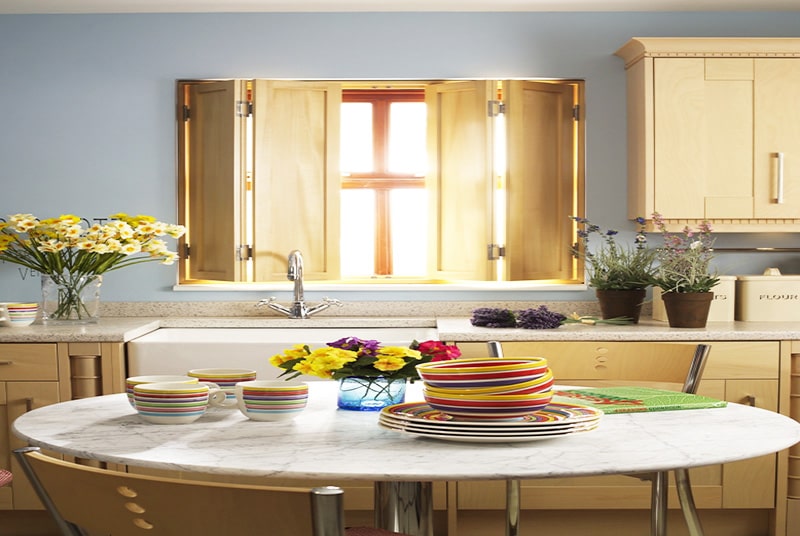
How to choose window shutters: materials, styles and operation methods explained
Choosing window shutters is about far more than finding a colour you like.
The material, colour, shutter style and the way the louvres operate all affect how your windows look, how much light and privacy you have and how well the shutters suit the room.
From natural wood and MDF to polymer options, and from full height to café style and tier-on-tier, there is plenty to consider before you choose.
Choosing the right material
Natural wood shutters are a popular choice where the appearance of real timber is important. The grain gives wood its natural character, and it can be painted or stained to suit your home.
Wood is lighter than other materials, which allows wider panels, but it is susceptible to moisture, so it is less suitable for bathrooms or rooms with heavy condensation.
MDF and composite shutters offer a smooth, even finish and are available in a range of styles and colours. They are usually heavier than wood, so panel widths tend to be more limited, and like wood they are not suited to wet areas.
Polymer shutters, a term covering vinyl (uPVC/PVC) and ABS products, are often water resistant, making them a popular choice for bathrooms and kitchens. Suitability depends on the specification of the individual product, and panel widths may be more limited to prevent flexing.
Price will vary according to the material, size, specification and installation, so a specialist can help you compare the options for your room.
Choosing a colour and finish
Wood shutters usually offer the widest choice, including whites, neutrals, bold colours and natural wood stains, and some suppliers can match a specific paint colour. MDF and polymer shutters tend to come in a more limited range of whites and neutral shades.
Which shutter style suits your window?
It should be noted that shutters tend to be opened only to access the window or to clean the glass behind them. While it’s possible to open the shutter panels, the sill in front of the window will often have ornaments and pictures on it that would need clearing first. It’s worth giving some thought to how you will live with them.
Full height shutters cover the entire window and are one of the most popular styles. Tilting louvres give you control over light and privacy, while the panels can be opened fully to let in more natural light.
On taller windows, a mid-rail adds strength and can allow the top and bottom louvres to be tilted separately.
Café style shutters cover the lower part of the window, leaving the top open for natural light. They are ideal where a room is overlooked from the street. The louvres can be tilted to adjust light and privacy, and the panels can be opened when you want more light.
Tier-on-tier shutters have separate top and bottom panels that open independently. This makes them a versatile choice where you want privacy across the lower half of the window while being able to fold back the top panels for light and ventilation.
For large windows and patio or bi-fold doors, tracked shutters are another option. Panels slide along a track and fold neatly to one or both sides, rather than swinging open into the room.
Solid panel shutters, made without louvres, offer greater light blocking and a traditional look, while shaped shutters can be made to fit arched, angled and circular windows.
How should your shutters operate?
A visible tilt rod fixed to the front of the louvres is the traditional way to adjust them.
Hidden tilt shutters have no front rod: either a slim rod sits at the back of the panel, or a mechanism is built into the frame, so you simply move the louvres by hand for a cleaner look.
Split tilt lets you angle the top and bottom louvres independently, which is a very popular feature.
Motorised shutters can be particularly useful for larger installations or hard-to-reach windows. Depending on the product, louvres can be controlled by a remote handset and some systems can also be operated through smartphone apps.
As shutters have no operating cords or chains, they are also a good choice for homes with young children.
Consider light, privacy and energy efficiency
Louvre size affects how much light enters the room, the view through the window and the overall look.
Larger louvres let in more light and give a clearer view when open, while smaller louvres create a more traditional appearance.
Louvres typically range from around 47mm to 114mm, and larger sizes need enough window depth to clear handles when tilted.
Proportion is also important, as larger louvres look better on taller windows, such as doors or floor-to-ceiling glazing.
Shutters are designed to create privacy and diffuse light rather than provide blackout, so an additional room-darkening blind may be needed where greater darkness is required.
Shutters can also provide a degree of thermal insulation. BBSA-commissioned research by the University of Salford’s Energy House Labs found that the internal plantation shutter tested reduced heat loss through a modern double-glazed window by up to 28%.
Find the right shutter specialist
There is no single type of shutter that suits every window. A specialist can assess your window and advise on the material, style, panel configuration and operation method best suited to your needs, as well as measuring and fitting them correctly. Shutters are a long-term investment, so expert advice is highly recommended.
Use the BBSA member search to find an accredited blind and shutter specialist in your area.